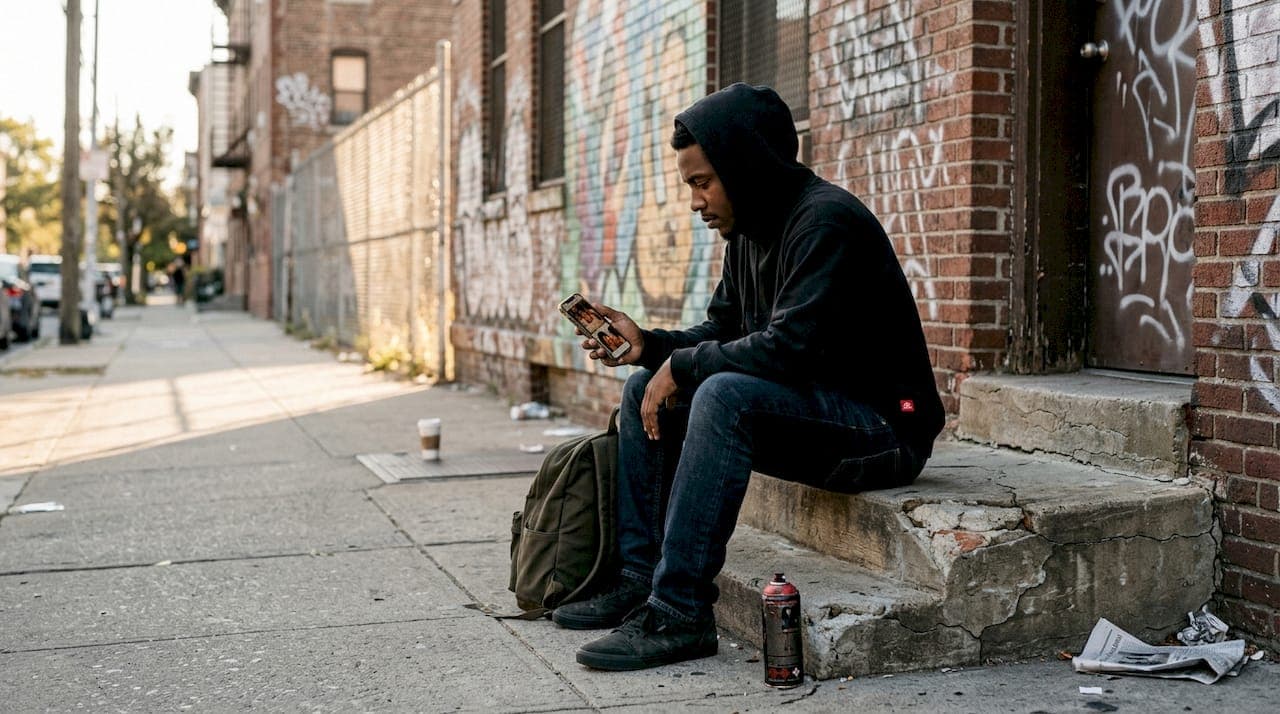
Forget the Bentleys, the diamond chains, and the hyper-saturated color grading that mainstream hip hop videos love to flex. Underground hip hop has always operated in a different visual universe entirely. It’s gritty, intentional, and loaded with meaning that goes way deeper than surface-level flash. The visuals in this space tell real stories: where you came from, what you’ve survived, what you refuse to accept. Whether you’re a fan trying to decode what you’re seeing or an artist building your own visual identity, understanding the aesthetics of underground hip hop is like learning a second language. One that hits harder than anything glossy ever could.
Table of Contents
Key Takeaways
| Point | Details |
|---|---|
| Authenticity is key | Underground hip hop visuals focus on real-life stories, places, and communities over polished production. |
| Political and cultural roots | Graffiti, fine art references, and resistance are central themes shaping these aesthetics. |
| Creative risk matters | Boundary-pushing visuals help sustain underground credibility and spark cultural debate. |
| Iconic art tells stories | Seminal album covers use imagery to build narrative, honor heritage, and connect with fans on a deeper level. |
Decoding the core elements of underground hip hop visuals
Mainstream visuals are built to sell a fantasy. Underground visuals are built to tell the truth. That’s the fundamental split, and once you see it, you can’t unsee it. The techniques used in underground hip hop aren’t accidental or low-budget by default. They’re deliberate. Every grain, every washed-out color, every cracked wall in the background is a choice.
One of the most recognizable signatures is the use of personal imagery. We’re talking childhood photos, family portraits, neighborhood block shots, and faces from the community. Album covers frequently use childhood photos overlaid on urban street scenes, evoking roots, come-up stories, and homage to community. That’s not nostalgia for nostalgia’s sake. That’s an artist saying: this is where I’m from, and I’m not pretending otherwise.
The visual vocabulary also leans hard on urban street scenes and graffiti motifs. These aren’t decorative choices. They communicate a connection to place, to struggle, to a specific block or city that shaped the artist’s entire worldview. You can explore how lo-fi hip hop visuals function as an extension of this authenticity, where the medium itself becomes part of the message.
Here’s a quick breakdown of how underground and mainstream visuals stack up:
| Element | Underground hip hop | Mainstream hip hop |
|---|---|---|
| Color palette | Muted, grainy, analog | Saturated, high-contrast, digital |
| Setting | Streets, rooftops, basements | Mansions, clubs, exotic locations |
| Imagery | Personal photos, community | Designer brands, luxury items |
| Production style | Lo-fi, intentional grain | High-budget, cinematic |
| Emotional tone | Raw, reflective, resistant | Aspirational, celebratory |
Key recurring motifs in underground visuals include:
-
Analog grain and film textures that evoke memory and impermanence
-
Muted or monochrome color palettes that strip away distraction
-
Graffiti and street art as political and cultural framing
-
Community faces and local landmarks that anchor identity to place
-
Collage techniques that layer history, present, and aspiration
Pro Tip: If you’re building your own visual identity, start with your phone’s oldest photos. The images that feel too raw or too personal are usually the ones that hit hardest. Don’t sanitize them.
The nostalgia embedded in these visuals isn’t soft or sentimental. It’s weaponized. It says: we remember where we came from, and we’re not going to let you forget it either.
Iconic examples and storytelling through album art
Theory is one thing. Seeing it in action is another. A few albums have essentially written the visual rulebook for underground hip hop, and they’re worth studying closely.
Nas’ Illmatic is the gold standard. That cover, a child’s face superimposed over the Queensbridge housing projects, does more storytelling in a single image than most artists manage across an entire career. It collapses time. You’re looking at the child and the man simultaneously, the origin and the outcome, the innocence and the weight. Foundational albums like Illmatic and Black Star’s records used vintage photo techniques and jazz and reggae visual influences in their cover art, setting a template that underground artists still reference today.

Black Star’s self-titled debut is another essential case study. Mos Def and Talib Kweli pulled from jazz and reggae visual traditions, incorporating illustrated effects and vintage camera aesthetics that positioned hip hop within a broader lineage of Black artistic resistance. That wasn’t accidental. It was a statement about where the music belonged historically.
Here’s how layered visual storytelling typically works in underground album art:
-
Select the anchor image (personal photo, neighborhood shot, or symbolic object)
-
Apply texture or grain to age the image and evoke memory
-
Layer secondary imagery (maps, graffiti, archival photos) to add context
-
Choose typography that matches the emotional register (hand-drawn, distressed, or minimal)
-
Limit the color palette to two or three tones to maintain visual cohesion
“The best underground album art doesn’t explain itself. It invites you in and trusts you to feel it.” This is the difference between art that performs and art that resonates.
You can see this philosophy alive in evolving hip hop visuals coming out of independent scenes, where artists like those featured at KFR are pushing the visual language forward without abandoning its roots. Check out Cryptic-X album designs as a real-world example of how these principles translate into current underground releases.
Political aesthetics: Graffiti, fine art, and resistance
Underground hip hop visuals don’t just tell personal stories. They argue. They protest. They take up space in a culture that has historically tried to push them out.
Graffiti is the most obvious thread here. It’s not just a visual style borrowed for aesthetic effect. It’s a practice rooted in claiming space, in making your mark on a city that doesn’t always acknowledge you exist. When underground artists incorporate graffiti into their visuals, they’re invoking that entire history of resistance. Underground hip hop visuals draw from graffiti as a political visual practice, using intertextuality with fine art tropes to challenge class distinctions and cultural gatekeeping.
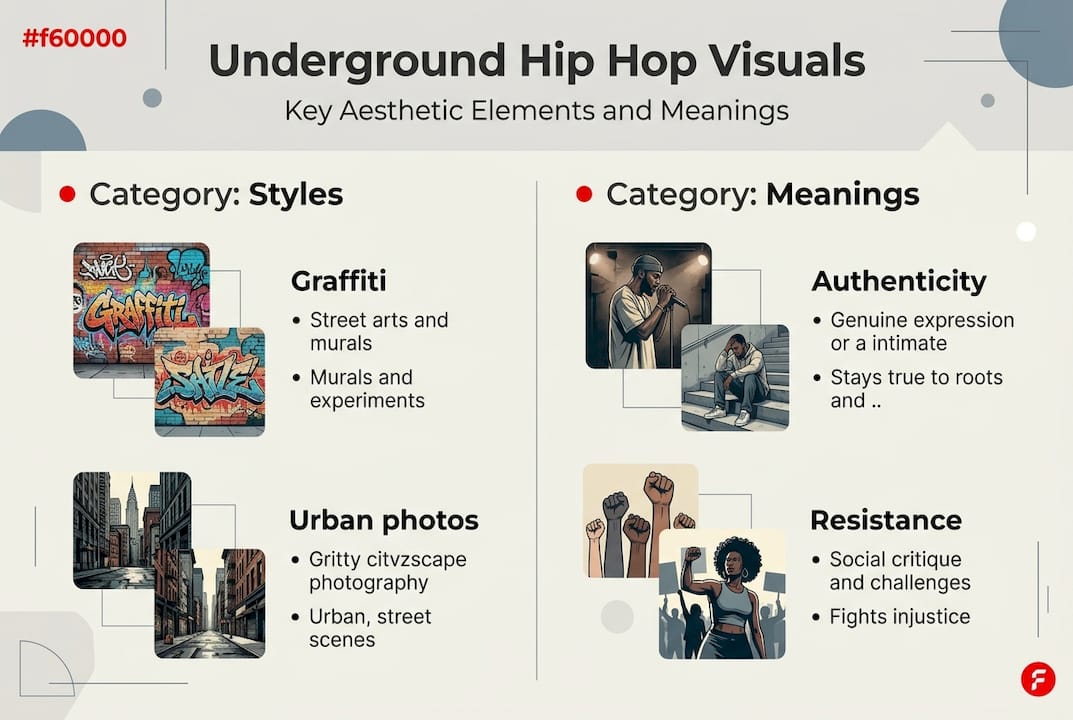
And yes, we’re talking fine art too. References to Michelangelo, Andy Warhol, and Jean-Michel Basquiat show up in underground visuals not as pretension but as a direct challenge to the idea that hip hop doesn’t belong in the same conversation as “legitimate” art. That tension is the point.
Key ways political aesthetics show up in underground visuals:
-
Graffiti-style typography that references street culture and protest
-
Imagery borrowed from political movements (raised fists, protest signs, archival civil rights photos)
-
Fine art references that position hip hop within high-culture conversations
-
Murals and local public art as backdrops that connect artists to community struggles
-
Distorted or fragmented imagery that mirrors the fractured reality of systemic pressure
“Graffiti was always about taking space, making a mark. Underground hip hop does the same thing sonically and visually.”
You can trace this same confrontational energy through the way artists approach graffiti techniques in visuals, where the aesthetic choices are never just decorative. They’re ideological.
Pro Tip: If you’re an independent artist, look at your city’s murals and public art. That’s free visual material loaded with local political and cultural meaning. Shoot in front of it, incorporate it, reference it. Make your visuals of your place, not just in your place.
Pushing boundaries: Controversial covers and creative risks
Sometimes underground visuals don’t just challenge. They provoke. And that provocation has consequences.
KMD’s Black Bastards is the defining example. The cover, featuring a cartoon character being hanged, was so inflammatory to industry gatekeepers that Elektra Records shelved the entire album before it could be released. KMD’s Black Bastards demonstrates the raw tension between underground provocation and mainstream limits. The album eventually achieved cult status, but the story behind its suppression became as important as the music itself.
This is the paradox of controversial underground visuals. The same imagery that gets you censored or dropped from a label can also cement your credibility and cultural legacy in ways that no marketing campaign could manufacture.
Here’s how controversial underground covers have typically played out:
-
Initial release or announcement generates strong reactions from fans and industry
-
Censorship or pushback from distributors, labels, or retail platforms
-
Underground circulation keeps the work alive and amplifies its message
-
Cult status develops as the controversy becomes part of the art’s identity
-
Cultural reassessment often follows, with critics and fans recognizing the work’s deeper significance
Shock value alone doesn’t build that kind of legacy. The covers that endure are the ones where the provocation is connected to something real: a political argument, a cultural critique, a refusal to be silent. Pure shock without substance fades fast. Shock with intent becomes history.
The underground hip hop ethos has always understood this distinction. Risk is part of the practice. But calculated risk, the kind rooted in genuine conviction, is what separates a stunt from a statement.
Why authenticity, not polish, defines underground visual impact
Here’s the take that most people won’t say out loud: a bigger budget often makes underground visuals worse. Not better. Worse.
When you throw money at the aesthetic, you start solving problems that weren’t actually problems. You replace the grain with clarity. You swap the neighborhood backdrop for a rented studio. You iron out every rough edge until the image looks like it could run in a magazine. And in doing that, you launder the blood out of it.
Mainstream visuals chase perfection because perfection is the product. Underground visuals resonate because imperfection is the truth. The cracked wall, the overexposed photo, the slightly off-center composition: those aren’t mistakes. They’re evidence that something real happened here.
I’ve seen artists come up in the underground scene and then, the moment they get a little budget, immediately try to look like what they’ve been rebelling against. That’s a trap. The real-life aesthetic choices that built your credibility don’t become irrelevant when you have more resources. They become more important to protect.
True influence in this space is measured in cultural impact, not production value. Focus on honest personal stories. Keep the grime where it belongs.
Explore more underground hip hop visuals and artists
If this breakdown lit something up for you, good. Now go deeper. The visual culture of underground hip hop isn’t something you fully absorb from one article. You experience it by actually digging into the music, the art, and the artists who are living it.

At Killing Field Records, we’re not just talking about underground aesthetics. We’re building them. Browse the full discography to see how visual identity and raw sound work together across our releases. Check out our featured artists to see what underground visual storytelling looks like in 2026. And if you want to understand what this underground hip hop label is actually about, start at the source. Real music. Real visuals. No apologies.
Frequently asked questions
What makes underground hip hop visuals different from mainstream hip hop?
Underground visuals prioritize authenticity, lo-fi techniques, and personal or political themes instead of polished, commercial looks. The deliberate low-production choices are a rejection of commercialism, not a limitation of resources.
Why do so many underground album covers use childhood or street photos?
These images evoke artists’ origins and emphasize authenticity and connection to their community. Childhood photos overlaid on urban street scenes communicate come-up stories and homage to the people and places that shaped the artist.
How does graffiti influence underground hip hop visual aesthetics?
Graffiti contributes political symbolism, a street edge, and an ethos of resistance to underground visuals. Graffiti as a political visual practice challenges class distinctions and cultural gatekeeping in ways that align directly with underground hip hop’s core values.
What are some examples of controversial underground hip hop album covers?
KMD’s Black Bastards is the standout example, featuring imagery so provocative that the album was shelved by its label before release, later achieving cult status.
How can independent artists develop their own underground visual style?
Start by reflecting your personal history, draw on local visuals, and keep production intentional rather than chasing polish. Thematic integration of comics or jazz influences can also build a deeper, more distinctive artistic identity over time.