
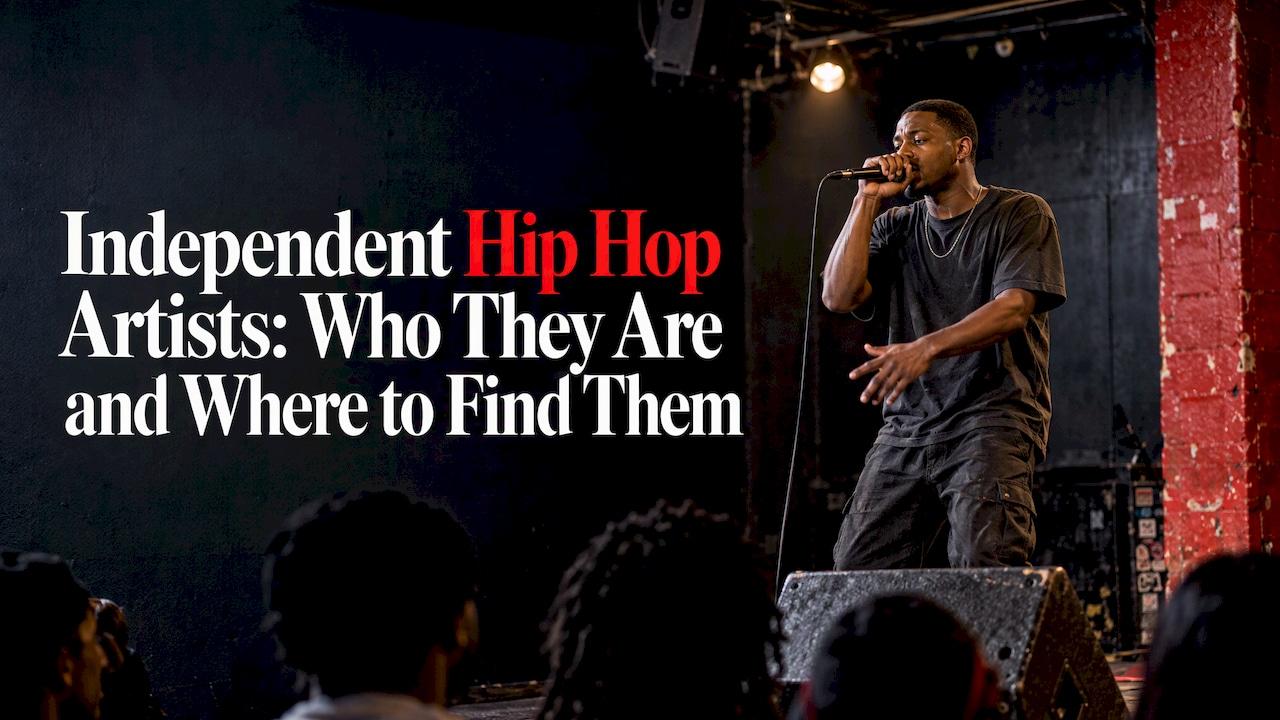
An independent hip hop artist is a rapper who owns the decisions: what gets recorded, what gets released, and how it is presented. Some work alone. Some work with small labels, distributors and engineers. What they share is that no major-label authority has the final say. Below you will find how to tell who is really independent, a short listening list across styles, how the scene looks in Nebraska, and how we think about all of it at Killing Field Records in Lincoln.
TL;DR
- Independence is about control and ownership of the work, not about being unknown or working alone in a bedroom.
- Chance the Rapper is the name most people give for the biggest independent rapper. The underground runs much deeper than that, through experimental, introspective and horror-leaning rap.
- To find new independent rap, follow the engineers, collectives and small labels behind the records, not only the rappers.
- Lincoln, Nebraska has its own independent scene. Killing Field Records is part of it, with every release mixed and engineered in-house.
- Our artists page and discography are the quickest way into our catalog.
Table of Contents
- What makes a rapper independent
- The biggest independent rap artist
- Independent hip hop artists worth hearing now
- Independent rap in Lincoln and Nebraska
- How we think about independence at Killing Field Records
- Where to find independent hip hop radio
- How independent rappers get heard without a major label
- Start with Killing Field Records
- FAQ
- Sources
What makes a rapper independent
The simplest definition: independent means free from outside control, and in hip hop the "outside authority" has traditionally meant the major labels. An older industry paper on hip hop's business model defines independence that way and argues that technology and social media let rappers build an audience without that authority.
Noname gave one of the clearest modern versions in a Billboard interview. For her, being independent means being the number one decision-maker on what gets released, artistically and brand-wise, and wanting sole ownership of her work. She also said she built her business to be self-sustainable without large outside lumps of money.
Notice what is missing from that definition. Nothing says small, broke or lo-fi. A rapper can sell out theaters and still be independent. A rapper can have a tiny audience and be locked into a deal that decides everything for them.

Independent does not mean alone
People picture one person, a laptop and a bedroom. Reality is more crowded. Independent artists use distributors, hire engineers, partner with small labels, and run collectives. The question is who holds the keys when a decision has to be made.
There is also a performance side. A MIC piece on Chance the Rapper describes an "indie pose," where artists show listeners they are calling the shots, even when that is not fully true in every case. Treat the label "independent" as a claim worth reading closely, not a badge.
How to tell as a listener
You do not need a lawyer. A few quick checks tell you most of it:
- Check who is credited. Look at the label line and the credits on the release page. A small label or an artist-owned imprint is a good sign.
- Look at who mixed it. Independent records often come out of a close circle: one engineer, one producer, one crew.
- See who speaks for the music. Artists who announce their own releases, write their own notes and explain their own choices usually control them.
- Read the artist's own words. Interviews and liner notes say a lot about who decides.
The biggest independent rap artist
Ask ten fans and most will say Chance the Rapper. His third mixtape, Coloring Book, became the first streaming-only project to win the Grammy for Best Rap Album, and he is among the highest-grossing hip hop touring artists. That makes him the reference point for what independence can achieve at scale.
"Biggest" depends on what you measure: streams, ticket sales, awards or influence. Chance wins on visibility. The artists below win on influence inside the underground, where reputations spread through word of mouth, collectives and small-run releases.

Independent hip hop artists worth hearing now
This is a starting list, grouped by what you might be in the mood for. Descriptions come from critics who have written about them.
| Artist | What to expect | Good if you like |
|---|---|---|
| Maxo | Introspective, jazz-soaked haze with hand-spun production | Late-night, warm, reflective rap |
| Ghais Guevara | Politically charged rap over soul-chop and warped percussion | Dense, confrontational lyricism |
| LaRussell | Bay Area bounce, motivational bars, grassroots crowdfunding | Upbeat, community-driven rap |
| MIKE | Lo-fi soundscapes, jazz loops, dusty drums | Mind-bending lyricism, loose beats |
| billy woods | Dense lyricism, abstract imagery, radical thought | Experimental rap that rewards repeat listens |
| Roc Marciano | Storytelling and dense lyricism on his own terms | Gritty, cinematic street rap |
A few notes on why these names matter.
Maxo shows how much room a quiet record has. RapReviews calls his production hand-spun, raw, warm and intimate, which is a fair summary of what a lot of independent rap does better than glossy radio rap: it lets small details breathe.
billy woods is described by Revolt as a pillar of experimental rap that shapes the underground. If you want to see how far the genre can stretch without losing its edge, start there.
Roc Marciano is called the underground rap king by Rolling Stone, which also points to his discography as canonical exhibitions of storytelling and dense lyricism. Storytelling is the thread running through nearly everything on this list.
If you want it stranger
Bandcamp Daily's guide to art rap describes avant-garde rap as antithetical to terrestrial radio playlists, with left-field production, unconventional song structures, fictional-character perspectives and ongoing social or political engagement. It names Open Mike Eagle as the originator of the term. That is a good rabbit hole if mainstream rap has started to sound the same to you.
Independent rap in Lincoln and Nebraska
Nebraska rarely gets mentioned in the usual hip hop geography, and that is part of why its independent scene feels so self-made. There is real work happening here, including community and cultural programs. The Nebraska Music Festival's Crossroads project, for instance, featured the Dream Warriors, an Indigenous hip hop collective, in a 2024 residency with members Gunner Jules, Tall Paul, Mic Jordan and Twin City Tone.
That is the kind of scene you find when you dig: collectives, residencies, home studios and labels run by people who live down the street from their listeners.
How we think about independence at Killing Field Records
We are an independent underground hip hop label in Lincoln, Nebraska. My brother and I started it, and we run it the way we would want a label to treat us.
For us, independence is not a marketing pose. It is a set of decisions. All of our music is mixed and engineered in-house, which means the person who hears the record first is the person who cares most about how it ends up sounding. We have a bit of a rant about this in how I mix underground rap: the rough edges are often the point, and the wrong engineer sands them off.
It also means we answer for the artists. Jinx, our late artist, left instructions for his work, and we follow them. The Book of Colors trilogy is central to what we do, and we release what he asked us to release, in the spirit he wanted. No AI resurrection, no grave robbing with better software. The reasoning behind that is in Release Everything.
Our roster is built around storytelling, emotional depth and beats that take risks: hardcore rap, dark trap, bold experimental work. We publish full lyrics for vocal releases because if someone is going to sit with a record, they should be able to read what is being said.
That is what independent means to us. We decide, we mix it, we own the responsibility.
the author
Where to find independent hip hop radio
Independent and rap radio exists at several levels: noncommercial community stations, college and freeform shows, freestyle series run by larger stations, and internet radio. Each is a different way of hearing music that streaming algorithms would never queue up for you.
Some tips for using radio as a discovery tool:
- Follow the host, not the station. The taste of whoever books or selects the music is what matters most. Find a host whose picks you trust, then follow their shows.
- Use freeform and late-night slots. These are where unusual records tend to get played.
- Prefer 24/7 internet radio when you want depth. There is no segment clock, so tracks can run in long, mood-driven stretches.
We run our own 24/7 internet radio with high-bitrate and lossless streaming. It is free to listen to. It is an easy place to hear our artists next to each other and get a feel for the label's sound before you pick a record to spend money on.
How independent rappers get heard without a major label
The path is slower than a viral story suggests, and it is mostly steady work.
- Finish and mix the music properly. Production quality shows up fast on streaming platforms. Whether you do it yourself or with an engineer, a good mix is a basic requirement.
- Put the music where people already listen. Major streaming platforms are where fans stream and buy. Make sure every release links to them from one page.
- Publish the words. Lyrics pages help fans connect with the writing, and they give search engines something to read.
- Build a direct line to listeners. An email list, a site and social channels you control mean you do not depend on a single algorithm.
- Submit with care. Radio shows and blogs get a lot of messages. A short, specific email with a clear link, sent to someone whose show fits your sound, beats a mass blast.
- Find your crew. Collectives and small labels share audiences. MIKE, for example, is described by Revolt as the founder of the sLUms. collective with a prolific catalog, a reminder that independent artists often build their own small ecosystems.
If you are an artist looking for a label that respects your vision, read about how we brought on a vocalist in KFR Signs BLXXDSHOT.
Start with Killing Field Records
If you like dark, raw, story-driven rap, we built our catalog for you. A few places to begin:
- Black by Jinx, with the full lyrics on site, and Sanguine by Jinx, from the late artist whose Book of Colors trilogy anchors the label.
- Sugar Cones, for bold, experimental sounds.
- Hot as Fuck by enemyX, Red by Populus and Style X by Cryptic-X, for singles and releases that show the range of the roster.
Every release links out to the major streaming platforms, so you can listen where you already do.

Browse the whole Killing Field Records site to see the roster, read lyrics and tune in to the radio.
FAQ
Who is the biggest independent rap artist?
Most people name Chance the Rapper. His Coloring Book was the first streaming-only project to win the Grammy for Best Rap Album, and he has built a large touring business. Other measures, like underground influence, point to artists such as billy woods or Roc Marciano.
What is the difference between indie and independent hip hop?
In everyday use they mean the same thing. Both describe artists who control their own releases and are not tied to a major label's authority. "Indie" often hints at a style or attitude as well, which is why it can sound like a pose when it is not backed by real ownership.
Can an independent rapper work with a label?
Yes. Independence is about who makes the final decisions and who owns the work, not about working alone. Many independent artists work with small labels, distributors and engineers. The key is the deal: look for one that leaves creative control with the artist.
Where can I hear independent hip hop radio?
Try noncommercial community stations, college and freeform shows, and 24/7 internet radio. Follow hosts whose taste you like. We run a free 24/7 station with high-bitrate and lossless streaming on our site.
Sources
- Maintaining Independence: Hip-Hop's New Business Model
- Noname On Why Being Indie Is 'Part Of a Greater Legacy'
- How Chance the Rapper became the gold standard for DIY music
- Chance the Rapper
- Underground pressure: 10 independent rappers you need to hear in 2025
- 15 must-know independent rappers and R&B singers
- Roc Marciano Interview: Underground Rap King
- A Walk Through The Avant-Garde World of Art Rap Music
- Dream Warriors Project Part 1